
All Aboard For Labadee: The Ultimate Tourist Prison
While news coverage of Haiti is, more often than not, quite bleak, what’s hardly mentioned is that on its northern coast lies a little utopia...for tourists only.

I believe that when you’ve got the world at your fingertips, it’s easy to get lost in it. Everything’s happening, everywhere all at once, and frankly, we’ve lost the plot. Certain truths have been buried under layers of stereotypes, myths and one-sided histories, so I’ve set out to find them.
But I can’t keep doing that without your support. This work depends entirely on readers like you, so if you can, please consider becoming a paid subscriber. Stories like these matter, your support makes sure they keep getting told!
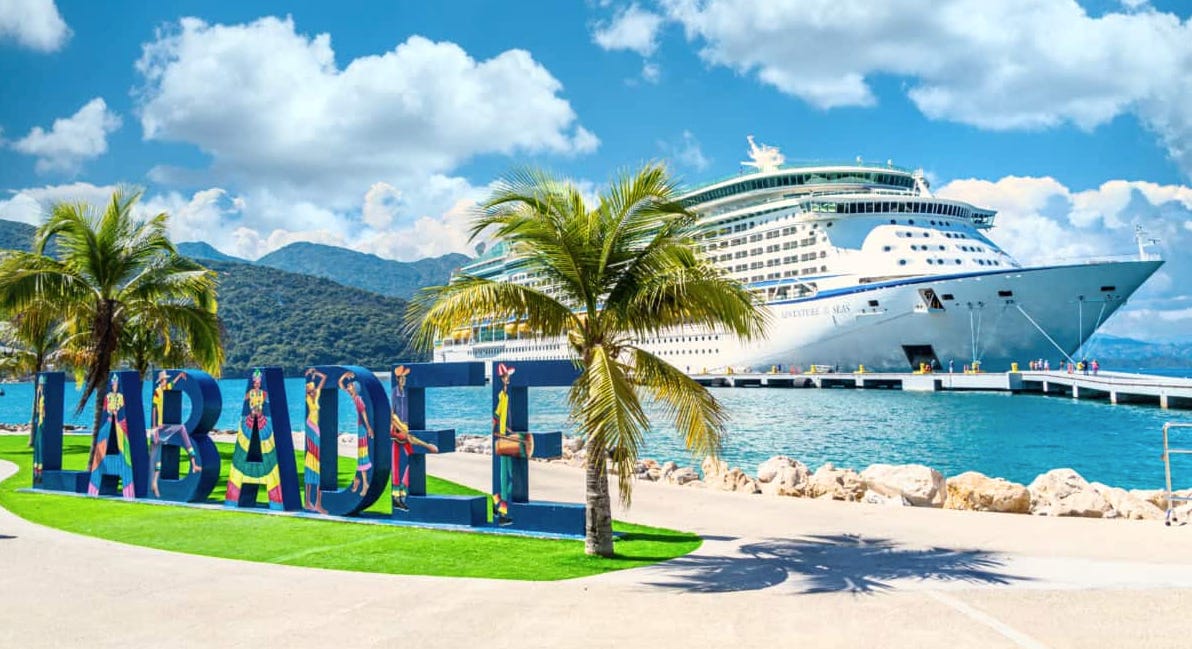
Since 1986, Labadee™ has been leased by Royal Caribbean Cruise Lines and promoted as an “endless adventure” with “pristine sands, coral reefs and jungle-covered hilltops nestling lagoon-like bays.”
What’s not being mentioned, however, is that this tropical slice of heaven is completely closed off to locals. Literally. A large barbed wire fence and guards with guns make sure that Labadee remains the wonderland it claims to be. Inside, everything from the food to the name has been westernised and simplified for comfort (no, don’t think about how Labadie is named after an enslaver, sip imported juice instead!)
So, while the outside grapples with the ravages of natural disasters, poverty and political instability, Labadee touts a tropical paradise.
There is indeed beauty in Haiti, it just isn’t accessible to Haitians. But how did we get here?
A Tale of Two Labadees
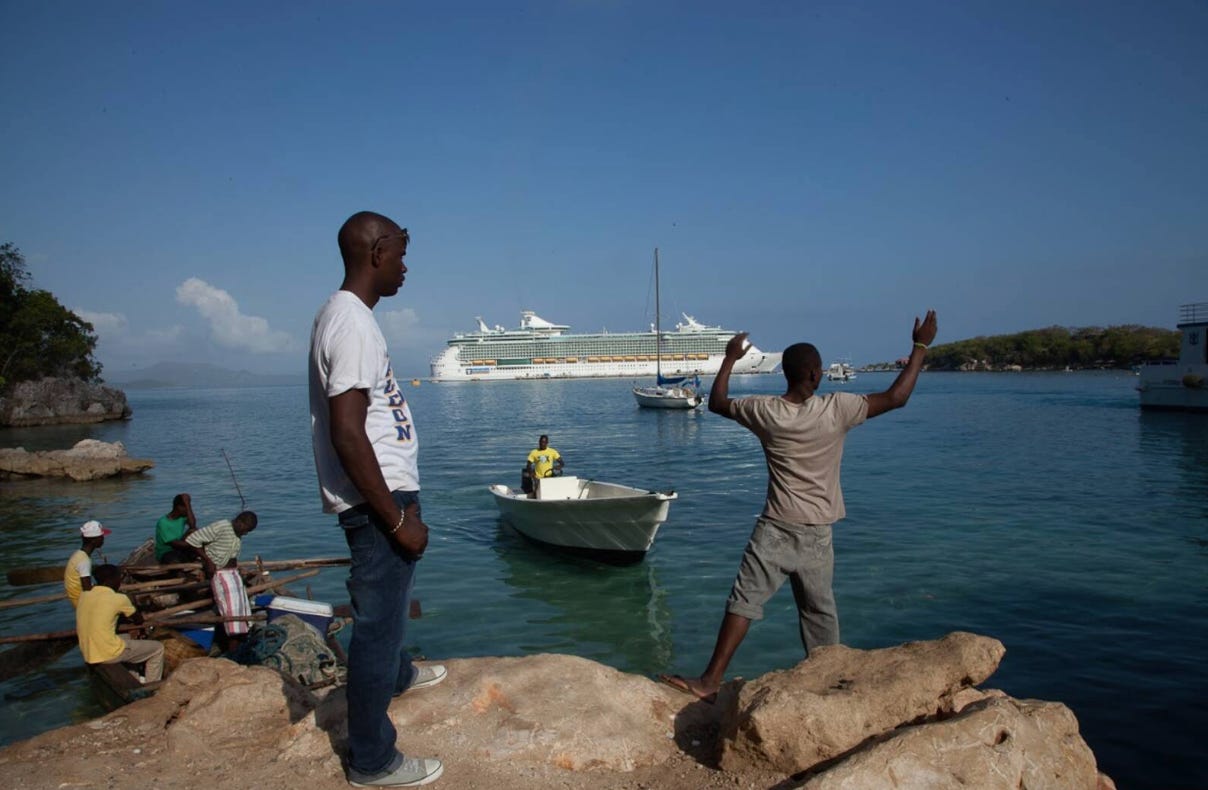
Several days a week, a towering cruise ship docks at the 105 hectare private resort (260-acre) of Labadee and thousands descend on its white sand beaches, cabanas, shops and flashy attractions.
On one side you’ve got the world’s longest zipline over water, on the other; an inflatable water playground — and if you’re feeling a little more adventurous: check out the Artisan’s Market, the only nod made to Haitian culture. But don’t wander too far off (not that you could anyways) we wouldn’t want the magical mirage of Neverland to become undone.
Half a million tourists stop in Labadee each year, making it Haiti’s biggest tourist draw. But when they all retreat to their ship after a long day of relaxation, the local staff head back to their own version of Labadie, one that is a far cry away from the fun, beauty and excess contained within the resort’s 3 meter (10 foot) walls.
As one local says, “there are two Labadies: one for the rich, the foreigners; and the other for the rest of us.”
Labadee seems to be in a Disneyesque world of its own, really an entity completely detached from the rest of the country. This was made quite evident when, after the 2010 earthquake devastated Port-au-Prince, Haiti’s capital city, cruise ships continued to dock in Labadee.
And today, although violent groups have forced more than one million people from their homes and more than 35% of the population lives on less than 2 dollars, in Labadee there is clean water, electricity, fun and abundance.
Compared to the rest of the country, Labadee seems to be thriving.
But, to understand how that is and why Haiti has been embroiled in turmoil for so long, it’s important to understand its history.
The World’s First Black Republic
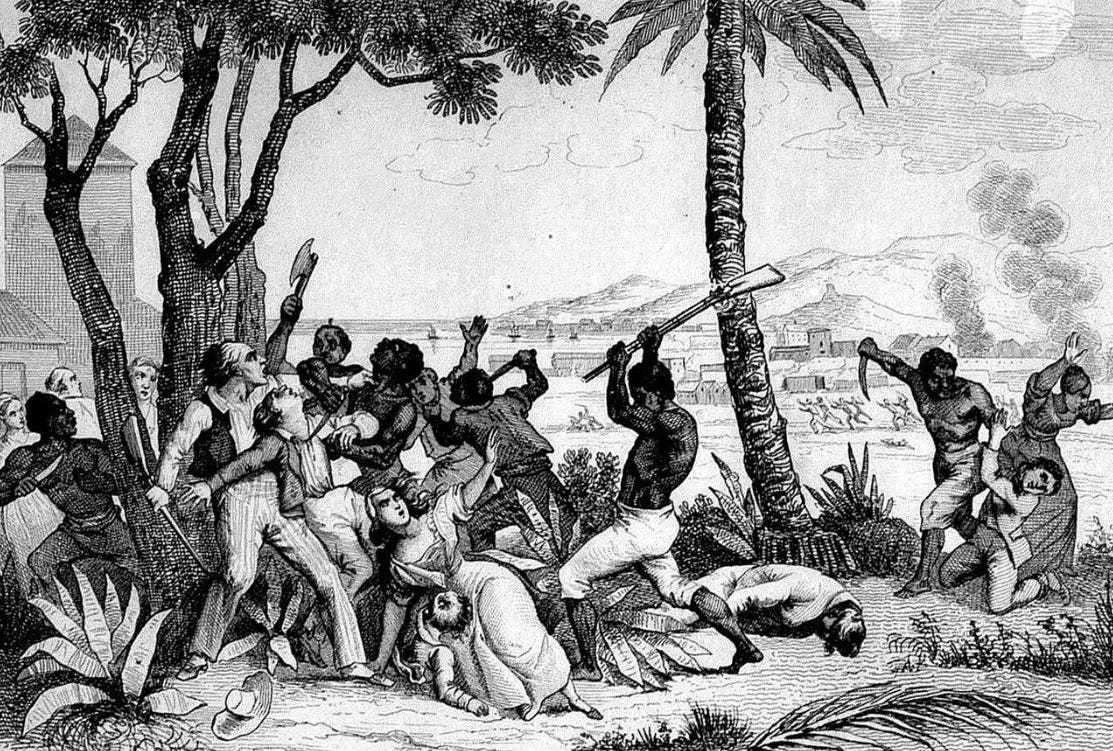
The history we know, at least, begins when Columbus “discovered” the island in 1492. He called it ‘La Isla Española,’ — now known as Hispaniola — and set up a colony.
Long story short; the indigenous people, called Taínos, were practically wiped out, and thousands of Africans were forcibly removed from their homes and shipped in to build the wealthiest colony in the world.
That wealth, of course, did not trickle down to the enslaved. Ultimately, the enslaved rebelled in 1791 — in what would come to be known as the Haitian Revolution — and founded the world’s first Black republic. *Haiti was actually the first nation to permanently ban slavery.
But daring to go against their oppressor had consequences. A black-led nation simply couldn’t be put on the same standing as its white-led counterparts (no no no, that threatened the world order!) so when Haiti won its independence it was immediately made a pariah state.
The United States immediately worked to isolate it economically, and France, almost literally at gunpoint, demanded that Haiti pay an exorbitant indemnity fee for lost property (i.e., slaves) to get diplomatic recognition.
The amount was so exorbitant in fact that Haiti had to take out loans — with high interest rates of course — from a French bank and it took the country 122 years to pay it off. So, from 1825 to 1947, Haiti paid French enslavers and their descendants the equivalent of roughly 25 billion dollars in today’s money.
Yes, Haiti was forced to pay its oppressor reparations.
And the United States’ violent occupation of Haiti for 19 years in the early 20th century further damaged the country’s progress. Not to mention that, even while the U.S. officially left Haiti in 1934, it continued controlling its public finances until 1947.
The Dark Side of Cruise Lines
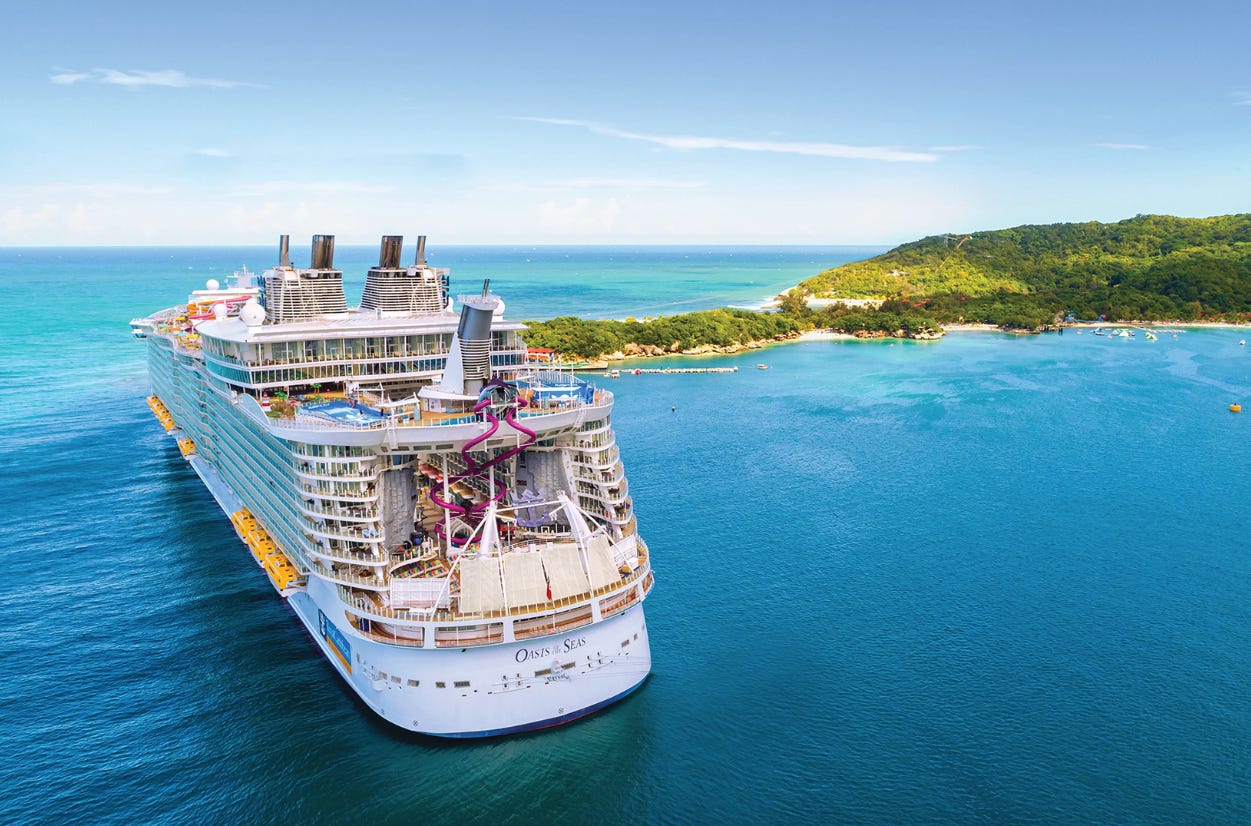
So, although today Haiti is one of the poorest nations in the world, that’s been by design…and it’s amidst all that turmoil that Royal Caribbean saw a business opportunity. As did then president Jean-Claude “Baby Doc” Duvalier it seems because in 1985 he personally signed a deal with Royal Caribbean.
The deal in question was a 64-year lease on a 25-hectare (61 acre) peninsula in northern Haiti. And so, in 1986, Labadee opened with little-to-no competition and became Haiti’s most popular tourist attraction.
The original name, Labadie, which itself was derived from French enslaver Marquis de La’Badie, was simplified for Western tongues, and the cruise line started marketing it as the ‘ultimate private beach.’
In fact, up until the 2010s, tourists didn’t even realise that the private beach they were visiting was in Haiti.
Throughout the 90’s the cruise line avoided all mentions of Haiti and instead marketed the destination as ‘Hispaniola.’ When they were called on it, they put a little Haiti here and there but continued to mystify Labadee as a ‘private’ and ‘secret’ destination.
A quote from a tourist in 2006 reads, “I thought we were coming to a place called Hispaniola, But I guess it doesn't matter. So, it's Haiti.”
The cruise line didn’t really go out of its way to clear up any confusion about the location of its private beach and that worked for them because in 2009, Royal Caribbean made 55 million dollars worth of improvements to their facilities and their lease was extended to 2050.
But, cruise companies buying land to build exclusive private retreats isn’t new. Since 2019, cruise lines have spent at least 1.5 billion dollars buying or leasing land in the Caribbean and companies like Disney Cruise Lines, Norwegian Cruise Line, Carnival Corp, MSC Cruises, Royal Caribbean Cruises have amassed some 15 islands and beaches totalling 2,104 hectares (5,200 acres) across the Bahamas, Belize, Mexico, Dominican Republic and Haiti.
However, while the promises behind all these investments are jobs and education grants, the reality seems to be quite different.
While there’s no denying that cruise lines bring an influx of money wherever they build, that also comes with a side of pollution in already ecologically fragile environments and the removal of public access to beaches.
This can be seen with Labadee, of course, and it can also be seen with Jamaica where local campaign groups say that only 1% of Jamaica’s population has access to its coastline.
As Dr. Devon Taylor, founder of Jamaica Beach Birthright Environmental Movement, says, “Jamaicans who for generations could just walk across the road and into the sea, can’t do it anymore. You may not even see a Black Jamaican in the sea. You may have a server, someone who will care for your room, and at the end of the day when they work their eight hours, they can’t take off their clothes and go and swim in the sea to relax, they have to walk through that gate and leave.”
But the blame doesn’t lie squarely with cruise ships or private resorts. They wouldn’t be building on these lands if the lands hadn’t been sold. The privatisation of beaches and sale of assets to foreign corporations has become quite normalised throughout the Caribbean because the governments selling those assets benefit from it.
For example, Royal Caribbean pays a 10 dollar tax per person to the local government, and with them bringing in more than half a million tourists each year, that’s a lot of moolah.
And I assume we’re talking big, heavy bucks because Royal Caribbean has continued operating in Labadee through political turmoil, dictatorships, earthquakes and gang violence.
While it did pause trips to Labadee for 7 months in 2024 because of State Department warnings and, well, optics, those optics didn’t seem to matter all that much because in October 2024 it quietly put Labadee back on its itineraries and has stopped there regularly since then.
And today, while armed gangs control about 85% of Port-au-Prince, Haiti’s capital, and 59% of Haitians live under the national poverty line, Royal Caribbean Cruises keeps on cruising to Labadee.
“Tourists don’t really understand Haiti, because what they see in the news or before buying their ticket isn’t the same as what’s really here.”
Now, it is easy to side eye Labadee and turn your nose up at what could really be defined as a tourist prison, but as with most things, the reality is a bit more nuanced.
As a Haitian travel operator said, “Aid has not aided Haiti. Haiti needs activity and Haiti needs jobs—and I believe right kind of tourism can bring that.”
It’s important to note that since 2001, there have been more than 15 natural disasters that have devastated Haiti, and although it’s received billions in foreign aid, suffice to say that the aid industry in Haiti has been “misguided at best, and outrageously corrupt at worst.”
For example, a 2015 Pro Publica investigation found that although Red Cross raised half a billion dollars after Haiti’s 2010 earthquake, it constructed just 6 houses.
So, when you’ve got a cruise line bringing in millions of visitors and beaucoup bucks, you’re not gonna turn it away, right?
Royal Caribbean is one of Haiti’s largest investors. It employs 200 locals from the nearby village of Labadie and allows another 300 to sell their merchandise on the premises.
The cruise line states that its workers earn well above the national average and in 2010, it built a new school (that incidentally, bears its name) and brought running water to the village of Labadie…but is it enough?
Everything in Labadee is owned and operated by Royal Caribbean and most payments are made with room keys or cruise cards, not cash. Not only does this mean no tip for employees but it also means that all earnings go directly into the hands of the company and not the locals.
As sociologist Ross Klein has said, “Unlike other port calls, on a private island [or in a private port like Labadee] the revenues and profits remain largely with the cruise line. So, while it's quite profitable to the cruise line, the benefit to the local economy is relatively small and very limited.”
It all feels a tad bit exploitative — and I’m not the only one saying it, cruise lines have been accused of exploiting poorer economies to maximise their profits.
In fact, critics have said that a non-privatised port in Labadie could be far more beneficial for both the local community and the country.
And beyond the economics of it all, most tourists don’t know or see how real Haitians live.
There is poverty and pain in Haiti, but just like anywhere else there is also beauty, culture and community. As a former cruise employee has said, “Tourists don’t really understand Haiti, because what they see in the news or before buying their ticket isn’t the same as what’s really here.”
Companies like Royal Caribbean do bring in valuable tourism revenue to Haiti, but not only do the locals seem to be getting just a fraction of that revenue, the tourism in itself doesn’t seem to be centred around Haiti’s cultural beauty.
Of course, the situation isn’t all black and white. The country is still plagued by decades of economic insecurity, corruption, violence, and natural disasters so tourism dollars are a welcome reprieve… but is Royal Caribbean really the best option?
I’m not going to claim to have the answer, but I’d say that it doesn’t include the exclusion of locals from their own land.
That only tourists have access to or fully benefit from a place purposely put out of reach to locals doesn’t sit right with me, nor should it.
Most Haitians don’t even know what Labadee looks like, they can only dream it. What’s that saying? Oh right: one beach for me but not for thee.